
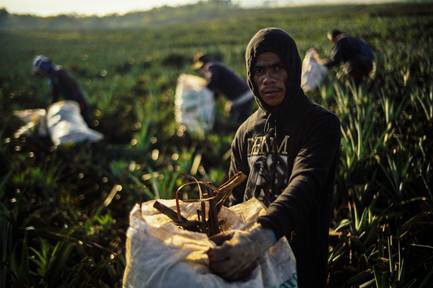
A pineapple farmer in Mindanao. [IMAGE: Design Center of the Philippines]
In a country that ranks among the world’s major pineapple producers, the fruit is a familiar fixture on Filipino tables — sweet, juicy, and packed with vitamins and fiber. But in recent years, the pineapple has taken on another life to emerge as a source of sustainable materials for the manufacturing industry.
The transformation begins with something most people take for granted – the leaves.
With millions of tons of pineapples harvested every year, vast quantities of leaves are left behind after the fruit is collected. What was once largely considered agricultural waste is now being reimagined as a valuable resource, thanks to an ambitious collaboration led by the Design Center of the Philippines (Design Center).
But it took a whole village (and a couple of years) to get there.
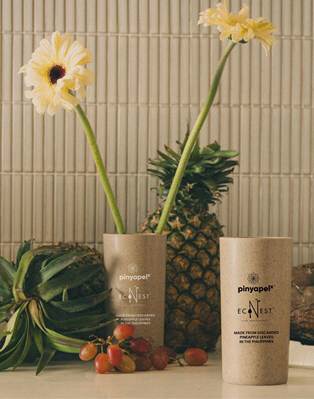
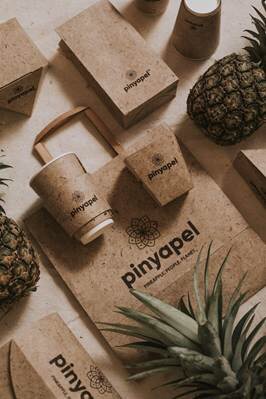
[IMAGE: Design Center of the Philippines]
In 2018, the Design Center brought together a network of stakeholders from across the pineapple industry — from farmers and pulp processors, to paper and packaging manufacturers — to explore what could be done with pineapple leaves.
The result was pinyapel®, a specialty paper made from locally sourced and processed pineapple leaves.
What began as an experiment in material innovation soon proved that sustainability could be both practical and beautifully designed. In 2019, pinyapel® earned a D&AD Future Impact Award, an international recognition for projects that use creativity and innovation to address some of the world’s most pressing challenges.
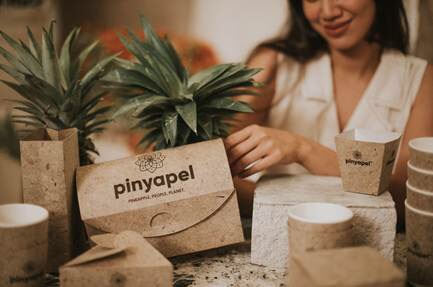
Packaging by Ideatechs Packaging Corp. made from pinyapel®.
[IMAGE: Design Center of the Philippines]
The accolade gave the project fresh momentum. The Design Center moved to take pinyapel® beyond the experimental stage and towards industrialization, opening up new possibilities for a locally developed material with applications across design and manufacturing.
To bring greater visibility to the material and its potential, the Design Center launched the pinyapel® Flagship Project at the Sustainability Solutions Exchange (SSX). Created by CITEM Philippines, SSX serves as a gateway to a growing network of global sustainability leaders and solution providers, while giving companies and brands access to ideas and resources that can support their own sustainability journeys. Design Center also partnered with the DTI-Competitiveness and Innovation Group (CIG) to create another platform for the wider business community – the pinyapel® Investors Forum to present the green pulp facility as a responsible and innovative investment.
Progress under the initiative will be showcased at the Sustainability Solutions Exchange 2026, running from October 15 to 17 at the Philippine Trade Training Center. Spearheaded by guest creative director-curator Stanley Ruiz, the showcase features 10 product development partners from diverse industries, demonstrating pinyapel® ’s versatility. Used on its own or combined with other materials, pinyapel® finds application in furniture, décor, packaging, and industrial products, highlighting its potential to transform agricultural waste into viable, sustainable design solutions.

Beyond Paper
A testament to its growing market presence, pinyapel®-based products are moving beyond trade shows and exhibitions into pop-ups and retail stores. Its versatility has opened up opportunities across industries, offering designers new ways to work with a material that transforms agricultural waste into products with a distinctly Filipino origin.
pinyapel®-based products can be lightweight, breathable and comfortable — qualities that make them particularly suited to life in the tropics. Take Lakat shoes, for example. The footwear line offers a soft, comfortable texture while allowing the feet to breathe, yet durable enough for everyday use.
Breathability, durability, plus diffuse capability, are some of the qualities that make the material ideal for furnishings and home decor, seen in the chairs produced by OMO Furniture, lamps by Tadeco Home, and accent pieces by Oro Handmade Innovations, to name just a few.
There are also food-contact grade containers and servers, alongside packaging and other specialty paper products made from pinyapel®.
It is this combination of sustainability, functionality and design potential that makes pinyapel® particularly compelling and appealing, most especially to this generation of consumers.
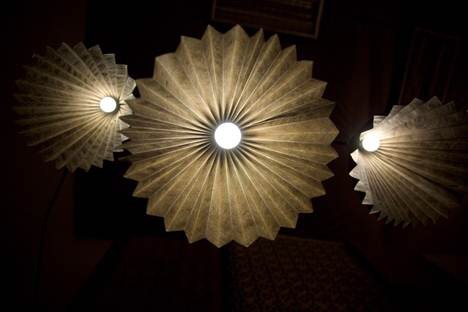
Overhead lights made with pinyapel® by Oro Handcraft Innovations
[IMAGE: Design Center of the Philippines]
The Bigger Picture
pinyapel® is ultimately a design success story, one that demonstrates what can happen when industry, government, creatives and manufacturers work together to rethink what we consider waste.
Its journey also offers a model that can be replicated and scaled. What began with a pile of discarded pineapple leaves has become a platform for experimentation, collaboration and new possibilities in design.
And perhaps that is the most exciting part of the story. Sometimes, the materials of the future are already around us. They are simply waiting to be seen differently, as demonstrated by manufacturers who now make use of the product.
To achieve the project’s full potential, a pulp mill in Mindanao is in the pipeline. This was identified by the Global Green Growth Institute and Korea International Cooperation Agency as one of the large-scale agricultural waste to biomaterials initiatives for the Agricultural Waste Circular Economy Project in the Philippines to be submitted to the Green Climate Fund.
Once built, thousands of pineapple farmers stand to benefit from the mill, which will have the capacity to process 20 metric tons of non-wood pulp from pineapple leaves. That’s a lot of waste turned to usable material, bringing us closer to a more circular, resource-conscious and waste-free future.
Know more about the pinyapel® Program here [pinyapel.carrd.co]. For inquiries, email info@designcenter.gov.ph or pinyapel@designcenter.gov.ph.

