
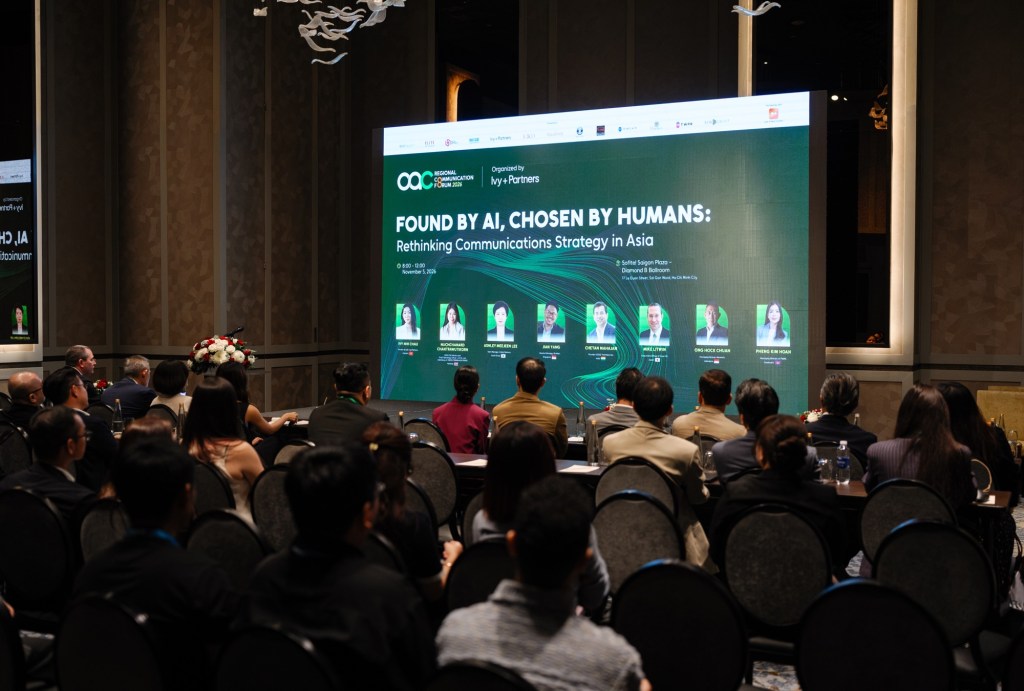
As AI increasingly shapes how people discover and evaluate brands, communications leaders from across Asia are urging businesses to look beyond visibility and consider a more fundamental question: what makes a brand worth trusting and choosing?
This was the central message emerging from the One Asia Communications (OAC) Regional Communications Forum 2026 held in Vietnam earlier this month. The forum brought together brands and communications professionals from 13 markets across Asia to examine the implications of AI for businesses and the communications industry.
“New tools and AI are changing how we work, but real impact across Asia still comes down to understanding people on the ground. Within the One Asia Communications network, we combine our regional perspective with deep local knowledge to help brands build genuine trust in every market,” said Noel Rene Nieva, President and CEO of Perceptions, Inc., a founding member and the Philippine representative of the OAC.
The forum explored the changing dynamics of brand discovery, the practical value of AI adoption, the evolving foundations of trust and the role of human judgment in communications across diverse Asian markets. Through keynote presentations, panel discussions and audience Q&A, the discussions highlighted a broader shift in how businesses need to approach communications as AI becomes increasingly embedded in the information and decision-making journeys of consumers.
Visibility is not the same as trust
As AI-powered platforms become another source of information for consumers, the way brands are represented in AI-generated responses is becoming an increasingly important consideration. Generative Engine Optimisation (GEO) is emerging as a new approach to improving brand visibility in AI-driven discovery. However, appearing in an AI-generated answer does not necessarily mean a brand is accurately represented or trusted. The information presented may draw on multiple sources, making the quality, consistency and credibility of a brand’s wider digital presence more important than ever.
This also raises questions about how brands manage the content and information that shape their representation across different platforms. As AI-generated content becomes increasingly common and harder for audiences to distinguish from organic material, businesses need to consider not only what they publish but also where and how they communicate.
AI visibility is therefore best understood as part of a broader reputation challenge. As Ivy Nhi Chau, Founder & CEO at Ivy+Partners, Vietnam, emphasised: “Reputation is shaped not only by what people encounter online, but also by stakeholder relationships and real-world experiences. For brands, the question is not simply whether AI mentions them, but whether that representation reflects a credible reputation built through consistent actions and relationships.”
More AI-generated content does not mean stronger brands
The growing adoption of AI is creating opportunities for businesses to accelerate research, content development and communications workflows. Yet the more important question is where the technology delivers meaningful value. AI can increase the speed and volume of content production, but relying on similar tools and outputs without a clear strategic direction can make communications less distinctive and weaken a brand’s ability to stand out.
“The gap between AI’s potential and its practical value is particularly relevant as businesses assess how the technology fits into their wider communications and reputation strategies. AI visibility and GEO can help brands understand how they appear in AI-driven discovery. But visibility data becomes useful only when it informs decisions about brand positioning, content and communications priorities,” Ong Hock Chuan, Managing Partner at Maverick, Indonesia, shared at the forum.
Together, these perspectives point to a broader consideration for businesses: AI visibility can help brands understand how they are represented, while reputation depends on what audiences experience and believe over time. The value of AI should therefore be measured not by how much content it produces or how widely it spreads, but by how well it helps build a credible, relevant and distinctive brand.
Regional scale requires local understanding
For brands operating across Asia, scaling communications involves more than translating messages or applying a consistent regional strategy.
The region brings together distinct languages, cultural references, media environments, stakeholder expectations and consumer behaviours. A message that is clear and credible in one market may be interpreted differently in another – and AI systems can reproduce these differences, or overlook them, depending on the information and context available. Across markets such as the Philippines, South Korea, Singapore, India, Thailand, Japan, Cambodia, Vietnam, and Indonesia, regional communications must account for these differences rather than assume a single Asian audience.
“As communication landscapes across Asia rapidly evolve through AI and emerging technologies, our greatest advantage remains our capacity for deep empathy and local understanding. Technology can scale a message, but it takes human judgment and cultural nuance to earn enduring trust,” Nieva added.
These considerations are particularly relevant in Asia, where a message that resonates in one market may not carry the same meaning or credibility in another. For businesses expanding across the region, a consistent brand direction needs to be supported by communications strategies that reflect local expectations, stakeholder dynamics and cultural realities. AI can help brands adapt and distribute messages at scale, but local understanding remains essential to ensuring that those messages are relevant and trusted.
Connecting regional perspectives on the future of communications
As AI becomes an increasingly influential part of how people discover and evaluate brands, visibility is only one part of the challenge. Businesses must also consider whether they are represented accurately, differentiated meaningfully and trusted across the markets they serve. The opportunity lies in combining AI’s capabilities with the human judgment, cultural understanding and relationships that give communications its value.
Through its network of independent communications agencies across 13 Asian markets, One Asia Communications (OAC)connects regional perspectives with local expertise. To know more about the OAC, please visit https://en.oneasiacomms.com/

